
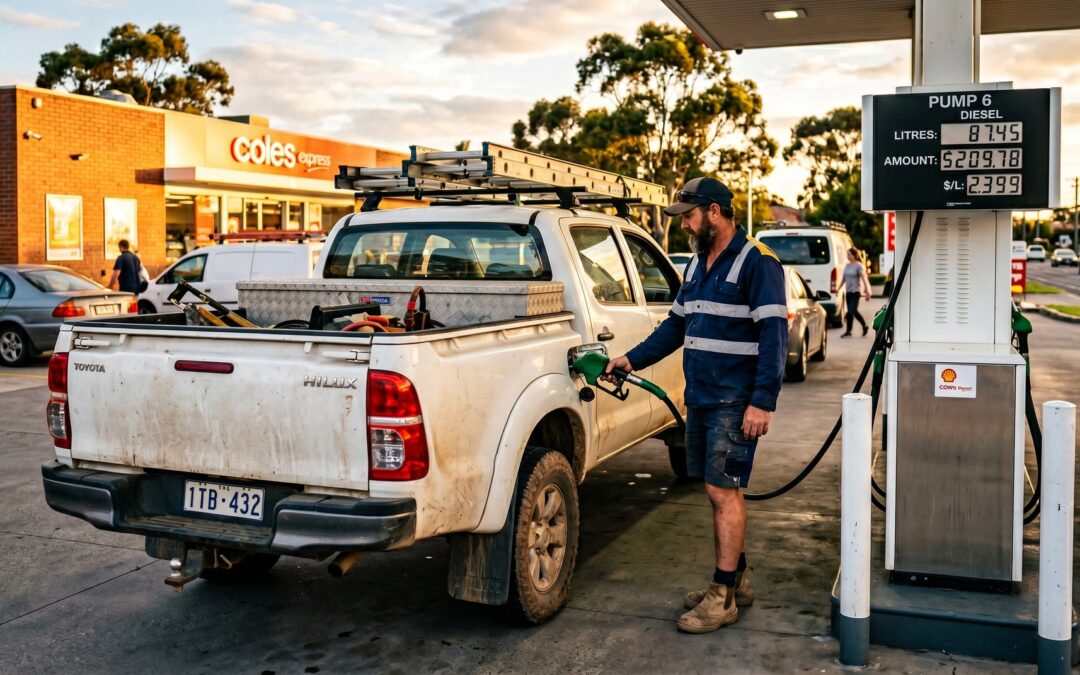
If you run a trade business in Australia right now, the numbers at the pump are doing something to your margins that a quiet price list will not fix. Diesel is sitting near $2.76 per litre and unleaded has cracked $2.03, with national averages hovering around 198 cents for petrol and 196.5 cents for diesel after a sharp jump earlier in the year.
For a sparkie running two utes, a plumber with a small fleet, or an earthworks contractor burning diesel by the drum, that is not a rounding error. It is a direct hit to the bottom line, every single day.
Here is what most operators miss. The situation is hard, but it is also full of mechanisms, concessions, and quiet levers that can meaningfully offset the pain. Some are tax driven. Some are operational. Some are commercial. Most are underused because nobody in the business has sat down long enough to look.
This article walks through what is actually going on, what you can claim, what you can change, and where the real opportunity sits for Australian trade businesses through to 30 June 2026 and beyond.
What Is Actually Happening With Fuel Right Now
A few moving parts are worth understanding before you make any decisions.
From 1 April 2026 to 30 June 2026, the Australian Government temporarily cut the fuel excise by 60.9 per cent, dropping it from 52.6 cents per litre to 20.6 cents per litre. At the same time, the heavy vehicle road user charge was suspended.
That sounds like good news across the board. It is not, and the detail matters.
For off-road business use, which includes a lot of trade activity such as generators, auxiliary equipment, machinery on private land, and farming, the fuel tax credit you can claim back has actually dropped because the excise that sits inside the price has dropped. For heavy vehicles on public roads, the fuel tax credit has nudged up slightly.
The takeaway is simple. The cents per litre at the bowser may look friendlier for a short window, but what you can claim back through your BAS has shifted. If you are not updating your fuel tax credit rates in your March and April BAS correctly, you will either miss money you are owed or claim money you are not entitled to. Both cost you.
Fuel Tax Credits: The Claim Most Tradies Leave on the Table
Fuel tax credits are one of the most overlooked line items for small trade businesses. If you use fuel in machinery, heavy vehicles, generators, or equipment as part of running your business, you can claim some of the excise back through your BAS.
The rules changed on 1 April 2026, and they change regularly. Rough current picture for liquid fuels like diesel and petrol used in all other business uses, including powering auxiliary equipment of a heavy vehicle, you can claim 52.6 cents per litre (before the April cut, now reduced during the excise cut window). Heavy vehicles travelling on public roads can claim around 20.6 cents per litre.
Three practical points matter more than the rates themselves.
One, you need to use the rate that applied on the date you acquired the fuel. Not the date you paid the invoice, not the date you lodged the BAS, the date you bought the fuel.
Two, if you are running a split business, say a civil contractor with excavators on private land and tipper trucks on public roads, you need to apportion the fuel usage. One rate does not fit all.
Three, the ATO offers a free fuel tax credit calculator. If your bookkeeper is not using it or your accountant has not revisited your fuel claim for the 2025-26 income year, there is almost certainly money sitting there.
For a business burning $80,000 to $150,000 worth of diesel a year, getting the claim right is not a rounding exercise. It can be thousands of dollars back in the business.
The $20,000 Instant Asset Write-Off Window Is Closing
The $20,000 instant asset write-off has been extended until 30 June 2026. From 1 July 2026, unless the government legislates another extension, the threshold is scheduled to drop back to $1,000.
Let that sink in. From $20,000 per asset, per purchase, to $1,000.
If your aggregated turnover is under $10 million, every eligible depreciating asset under $20,000 that is first used or installed ready for use before 30 June 2026 can be fully deducted in the current financial year, instead of depreciated over several years.
That changes the maths on a lot of purchases trade businesses are already considering.
A $17,000 set of welders, a $12,000 compressor upgrade, a $15,000 second-hand ute, tools, diagnostic equipment, trailers, site sheds, software, each one can be deducted in full rather than written down slowly. The cost is the same, the cash flow impact of the deduction is significantly better.
The threshold applies per asset, so you can write off multiple assets as long as each one is under the limit. It is not a combined cap.
The trap here is business owners sitting on the fence, trying to time the purchase for July, and losing a substantial chunk of the tax benefit in the process. If you were already going to buy the equipment, buying it before 30 June 2026 is likely the better call. If you were not going to buy it, this concession is not a reason to spend money you do not need to spend.
Your Vehicle Deductions Are Probably Wrong
Most tradies pick the easier method and claim the cents per kilometre rate, which is 88 cents per kilometre for 2025-26, capped at 5,000 business kilometres per car, per year. That is a maximum claim of $4,400 per vehicle using that method.
For anyone driving more than 5,000 work kilometres a year, which is almost every trade business, the logbook method is almost always better, and usually by thousands.
Here is how the logbook method works. You keep a compliant logbook for a continuous 12-week period that is representative of your typical travel. You work out the business-use percentage. You then apply that percentage to all your actual vehicle costs for the year, including fuel, registration, insurance, servicing, tyres, depreciation, and interest on a car loan.
For a tradie driving 40,000 kilometres a year with 75 per cent business use, the logbook method can produce $8,000 to $12,000 in deductions. That is two to three times the cents per kilometre cap.
A valid logbook must include start and end date and time of each trip, odometer readings at start and end, kilometres travelled, and the business purpose, for example, “travel to client site, Smith residence, Parramatta”. The logbook must cover a continuous 12-week period, and you need the odometer readings at the start and end of that period.
The ATO data matches vehicle claims against income and industry norms. Claims of 100 per cent business use, round numbers for every trip, and the same percentage year after year without a current logbook are classic red flags. Get the logbook right, and the numbers tend to look after themselves.
Small Business Energy Incentive Has Closed, But the Lesson Has Not
The Small Business Energy Incentive gave eligible businesses a 20 per cent bonus deduction on energy-efficient assets and improvements installed between 1 July 2023 and 30 June 2024, capped at a $20,000 bonus deduction per entity.
If you made energy efficiency upgrades during that window and have not claimed the bonus deduction, it is worth a conversation with your accountant. Some businesses claimed it, many did not.
More importantly, the underlying logic has not gone away. Electrifying equipment, switching to more efficient compressors, moving to LED lighting on workshops and yards, upgrading to energy-efficient ovens and appliances in hospitality, and installing monitoring and storage all tend to pay back faster when energy costs are rising.
Fuel is not the only input cost biting right now. Electricity, gas, and insurance have all moved. The businesses that treat energy as a cost to actively manage, not a bill that shows up, tend to claw back a meaningful margin over two to three years.
Operational Levers That Usually Beat the Tax Stuff
Tax concessions are valuable, but the real wins in a high fuel cost environment are almost always operational. A few areas where trade businesses consistently leave money on the table.
Route and Scheduling Discipline
Most small trade businesses schedule jobs by customer request, not by geography. That means the team is criss-crossing town all day, burning fuel, and losing billable hours to drive time.
Clustering jobs by suburb, running “north day, south day” structures, or using a simple job management system with route optimisation can strip 15 to 30 per cent of drive time out of a week. Less fuel, more jobs completed, better margins. Every one of those savings is after tax, which makes them more valuable than most deductions.
Fuel Cards and Fleet Data
Fuel cards give you discounts that usually sit between 3 and 8 cents per litre. Across a fleet of utes and trucks, that compounds. More importantly, fuel card data lets you see who is refuelling where, when, and how often, which exposes leaks you would otherwise miss.
Telematics and GPS data on vehicles do the same for driving behaviour. Idling, heavy acceleration, and routes that are not on job sheets all show up clearly when you look.
Pricing That Reflects Reality
A lot of trade businesses still quote off price lists that were built when diesel was $1.60. If your cost base has moved and your pricing has not, every job is quietly less profitable than the spreadsheet says it is.
That does not mean lifting every price across the board. It means revisiting your call-out fees, your hourly rate, your travel charges for out-of-area work, and your minimum job size. In most trade businesses, a disciplined review of pricing releases more margin than any fuel concession will.
Supplier and Inventory Decisions
Supplier pickups, returns, and chasing parts are some of the most expensive kilometres in a trade business. Setting up a weekly delivery schedule with key suppliers, holding a sensible level of commonly used stock in the van, and consolidating runs all reduce the unplanned trips that burn the most fuel.
The Confidence Picture You Are Working Against
None of this is happening in a vacuum. Roy Morgan Business Confidence dropped 8.8 points to 88.6 in February 2026, its lowest level in more than five years. Over two-thirds of Australian businesses, 67.2 per cent, now expect “bad times” for the economy over the next five years. That is a new record high for that indicator.
At the same time, the NAB survey has shown sales conditions still holding up at plus 16 earlier in the year, capacity utilisation at 83.2 per cent, and pockets of genuine strength.
The gap between how businesses feel and how they are actually trading is wider than it has been in years. That matters, because businesses that run on sentiment tend to cut marketing, pause hiring, and stop investing at the exact moment their competitors are doing the same. That creates space for the operators who keep their heads down and keep executing.
What a Sensible Trade Business Is Doing Right Now
Pulling it all together, here is a practical checklist for the next 90 days.
Review your fuel tax credit claim for 2025-26. Make sure the pre and post 1 April 2026 rates are applied correctly in your BAS. If your bookkeeper has not flagged this, flag it with them.
Revisit the vehicle deduction method. If you are still on cents per kilometre and driving more than 5,000 kilometres for work, start a 12-week logbook now. You can use the myDeductions tool in the ATO app if you want something simple.
List the assets you have been considering buying before June next year. If any are under $20,000 and you would buy them anyway, there is a strong case for pulling the purchase forward before the instant asset write-off drops back to $1,000.
Audit your pricing and your call-out structure. If you have not raised prices in the last 12 months, you have effectively taken a pay cut equal to CPI plus the fuel rise. That is not a strategy, that is a drift.
Run a fleet efficiency review. Where are your people driving, how often, and why. Fuel cards, route planning, and a simple geographic booking rule will usually produce the biggest fuel saving in the business.
Talk to your accountant before June, not in August. Every tax concession mentioned in this article has timing rules. Advice in June saves money. Advice in August just confirms what you cannot do anymore.
Where a Coach Fits in All of This
Most of the above is not rocket science. It is knowable, documentable, and fixable. The reason it does not get done is almost never a knowledge problem. It is a focus problem.
Trade business owners are flat out running jobs, managing crews, quoting, chasing invoices, and putting out fires. Sitting down for two hours to map out a fuel tax credit claim or build a pricing review feels like a luxury, even when it is worth ten grand.
That is the gap a good coach closes. Not by telling you what you already know, but by making sure the operational, financial, and strategic work actually gets scheduled, executed, and tracked. At Candour Strategy, we work with small and medium trade businesses across Victoria to do exactly that. Practical, commercially grounded, and focused on real numbers.
Fuel costs will go up and down. The businesses that come out of this period stronger will be the ones that used the pressure as a reason to tighten the operation, not as an excuse to wait it out.
If that sounds like the conversation you need to be having, book a strategy call with Candour Strategy and we will walk through your numbers together.